Saturday, September 10, 2016

Wonderland Day 1

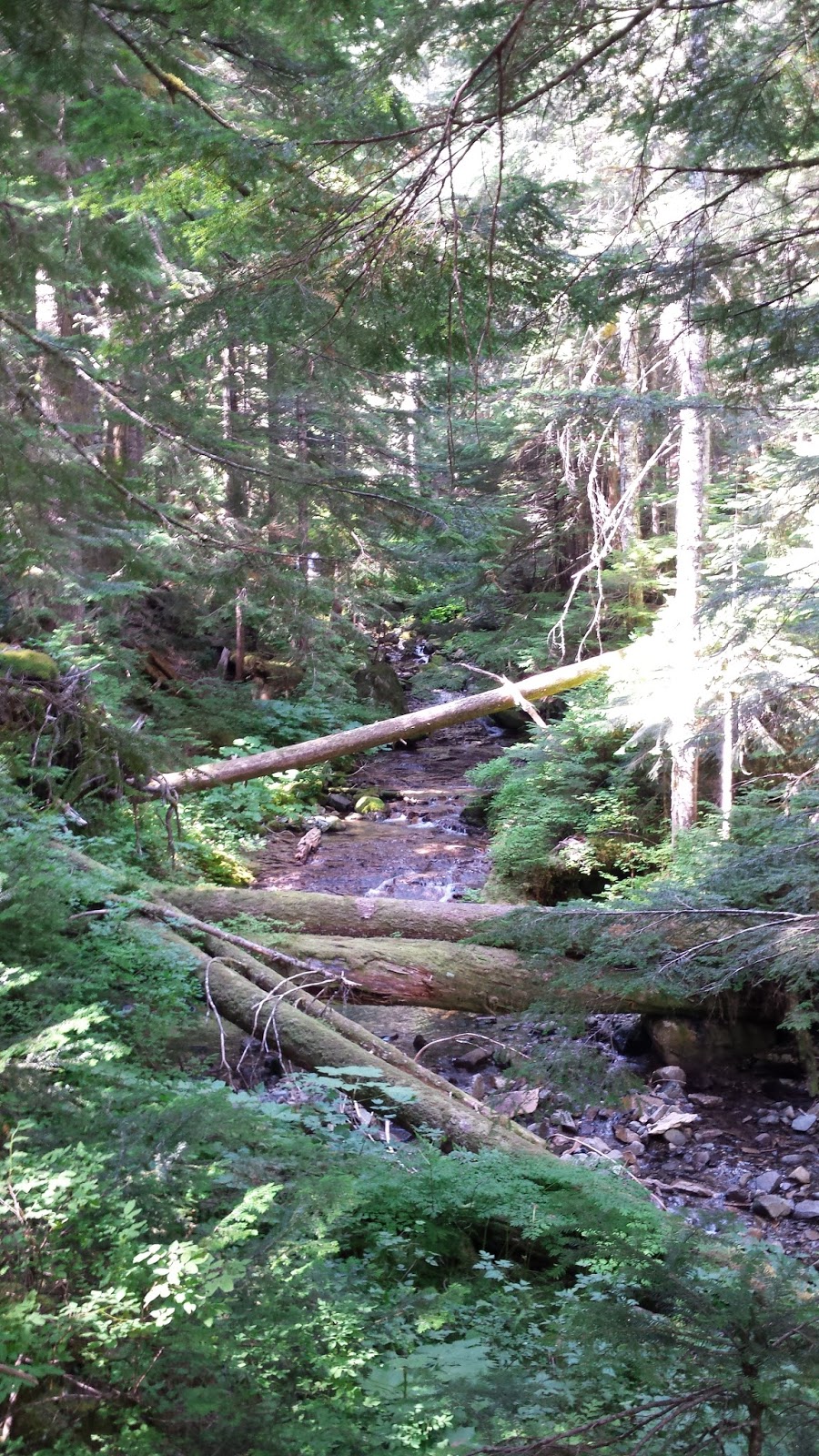
The Wonderland Trail has 22,000 feet of elevation change throughout its 93 miles so even if you think it's an easy day, chances are, it's not going to be easy at all.  Day 1, we "only" had 5.5. miles to go to get from Mowich to Ipsut.  This actually turned out to be for real an easy day!  We thought we had to scale Ipsut Pass but turns out we were going down the pass and not up so we lost a couple thousand feet in elevation to get to Ipsut camp.  We wandered down that pass eating blueberries, watching butterflies and standing with our mouths agape at the truly "wonderland" beauty!  If fairies and sprites lived, this is where they would be.

Ipsut camp was right next to the Carbon River which is glacier run-off.  You may think of glacier water as clear and pure and delightful but in reality it's pretty disgusting.  Very silty and lots of sediment, not filterable.

We got to our camp early and had time to actually be bored. In a few days, we would be grateful for early finish times that allowed additional rest.


Break Time!


Dinner!

2 hour post prandial after dinner.  Good.

Wonderland Day 0

Dennis was able to retrieve my pictures!! Yay! 
 
Day 0, Nancy, Ingrid, and I flew to Seattle, rented a car, and drove to White River on the north eastern edge of Mt Rainier National Park.  We had several itineraries to present to the Ranger since this year permits are walk-up only.  Ranger Carol shot down the first several so we put ourselves at her mercy and said we will do whatever you have available.  She is studiously checking the system below for viable options.


She figured out a 12 day itinerary for us going clockwise and we were overjoyed!  High fives and jumping all around!  This is what we ended up with:
 
Mowich Lake to Ipsut 5.4 miles
Ipsut to Cataract Valley 4.6 miles
Cataract to Dick Creek 12.4 miles including a detour into Spray Park
Dick Creek to Sunrise 12.5 miles
Sunrise to Summerland 10.3 miles
Summerland to Indian Bar 4.4 miles
Indian Bar to Maple Creek 9.8 miles
Maple Creek to Paradise  6.5 miles
Paradise to Devil's Dream 9.3 miles
Devil's Dream to North Puyallup 14 miles
North Puyallup to Golden Lakes 5 miles
Golden Lakes to Mowich Lake 10 miles
 
The Wonderland Trail makes you stay in designated areas so that's why the tight control on permits.  It was a refreshing change from the John Muir Trail and the Pacific Crest Trail, truth be told.
 
Now that we had permit in hand, we could kind of figure out if we could cache any food.  We decided to leave 4 days worth of food at White River since we would have to walk back through there anyway.
 
We exploded our packs in the ranger parking lot and went to work.  It was a haphazard free for all.  But we got our food into the cache bucket, labeled it correctly, and left it with the Ranger.  Then off we went to drive back around to Mowich lake (north western part of park), our starting point.  The rental car would be left at the Mowich parking lot for 12 days.  What a waste of money, right? Thankfully, we got a really good deal through Costco.


We made it to Mowich around 5pm and set up camp.  I met a solo lady named Marjorie who had fallen and cut herself and wasn't sure yet if she needed to get stiches.  I wonder what she ended up doing. 
 
I had also contacted Erin Saver AKA Wired, because I knew she was going to be on the Wonderland and being a long time blog follower of hers, I wanted to meet her! I have a history of recognizing people on trail whose blogs I follow and scare them with my exuberance so I was hoping to give Wired a head's up that I'd be looking for her.  Lots of good info on her blog: http://walkingwithwired.com/


Since I am doing a Diabetes Fundraiser for awareness in conjunction with this hike for the American Diabetes Association, I'll be talking about my diabetes on the trial.  I don't like it but I will :-)
 
2 hour post-prandial evening sugar level was 93.  Good.


Hunkered down to sleep, excited to start walking!!


Thursday, August 18, 2016

T Minus 4 Days to Wonderland

OMG, so close!  I am beyond anticipation!  This trip has taken forever to get here.  I think it's because I've talked about this trip more than any other due to the Diabetes Fundraiser.  Fingers crossed for getting a permit right away- I have butterflies!

#crazyclan #crazycompressionambassador #usamade


Friday, July 29, 2016

Crazy Compression Socks

You are now looking at an official Crazy Compression Socks Ambassador!  Woot!  Love these socks.  They have really helped with my leg and foot edema issues while hiking at altitude.  These will really come in handy on The Wonderland Trail.  I wish I had known about them sooner.

I'll be able to do a giveaway soon so stay tuned!

#crazycompression #crazyclan #usamade #crazycompressionambassador
www.crazycommpression.com

Mt Baldy Summit


Coffee break, rocking the socks, on Mt Baldy


Cucamonga Peak


Mt San Jacinto

Friday, July 22, 2016

The Other Diabetes

Say what?!  There's another type of Diabetes, you ask??  Not many doctors that I've talked to (I've talked to quite a few) believe this type of Diabetes exists.  I believe it though, so I'm gonna talk about it for awareness sake.

It's called Type 1.5 or LADA (Latent Autoimmune Diabetes in Adults).  I have also been tested for autoantibodies to rule this type out in myself.

Studies have shown that among the people who do not require insulin at diagnosis (most of whom were assumed to have Type 2 diabetes), a significant number showed autoantibodies, especially antibodies against islet cells and GAD. In other words, these people could be treated initially with diet therapy and oral medicines like people with Type 2 diabetes, but they also had an ongoing autoimmune process like people with Type 1 diabetes. The term “latent autoimmune diabetes of adults” (LADA) was originally applied to this subset of people with diabetes. It has also been dubbed “slow-progressing Type 1 diabetes,” and, in the late 1990’s, some researchers coined the term “Type 1.5 diabetes,” because it had features of both the major types.

Further study of these people who at least initially do not require insulin yet have autoantibodies has revealed some distinct variations, leading some researchers to subdivide those placed under the umbrella term LADA into three groups: Type 1–LADA, Type 1.5 or “double” diabetes, and Type 2 diabetes with autoantibodies. Under this scheme, people with Type 1–LADA are thought to have a more slowly progressing form of Type 1 diabetes. Like people with Type 1 diabetes, people with Type 1–LADA have autoantibodies and are usually not obese. Although they may initially be able to get by with diet therapy and oral diabetes medicines, they usually need to use insulin within about five years of diagnosis because of the destruction of their beta cells.

People with Type 1.5 diabetes are said to have “double” diabetes because they show both the autoimmune destruction of beta cells of Type 1 diabetes and the insulin resistance characteristic of Type 2 diabetes. People with Type 1.5 have autoantibodies and gradually lose their insulin-producing capability, requiring insulin within 5–10 years of diagnosis. As their insulin resistance suggests, many people with Type 1.5 diabetes are obese or overweight.

People in the third group are obese or overweight with insulin resistance like "most" people with Type 2 diabetes, and they also have autoantibodies. However, they still manage to produce insulin for more than five years after diagnosis and can continue to manage their diabetes with diet, exercise, and oral medicines. It is suspected that the autoimmunity in these people is very mild.

Some researchers suggest screening anyone newly diagnosed with Type 2 diabetes for GAD antibodies. In the United Kingdom Prospective Diabetes Study (UKPDS), most study subjects with Type 2 diabetes between 35 and 45 years old who tested positive for antibodies against both GAD and islet cells progressed rapidly to insulin dependency. Some researchers have also suggested that anyone who tests positive for GAD antibodies be screened for autoantibodies to thyroid and adrenal cells, because like people with Type 1 diabetes, people with Type 1.5 diabetes seem to be at higher risk of having other autoimmune diseases.

The jury is still out on the best way to treat Type 1.5 diabetes. Maintaining tight blood glucose control may help to slow the destruction of the beta cells (and delay insulin dependency) as well as reduce the risk of diabetic complications. A few small studies suggest that insulin therapy or insulin combined with rosiglitazone (brand name Avandia) may help to preserve beta-cell function, but these results need to be confirmed in larger trials. (Using insulin in combination with rosiglitazone may increase risks for people with heart failure.)

Source: http://www.diabetesselfmanagement.com/diabetes-resources/definitions/type-1-5-diabetes/

Tuesday, June 28, 2016

Diabetes Insipidus

Diabetes Insipidus is not related to Diabetes Mellitis (Types 1 & 2) in any way.  But I'm going to talk about it, nonetheless, because my brother has it.

Diabetes Insipidus is rare and causes an imbalance of water in the body.  It exhibits through extreme thirst as well as peeing alot.  There is no cure.

The most common signs and symptoms of diabetes insipidus are:
  • Extreme thirst
  • Excretion of an excessive amount of diluted urine
Depending on the severity of the condition, urine output can be as much as 16 quarts a day if you're drinking a lot of fluids. Normally, a healthy adult will urinate an average of less than 3 quarts a day.
Other signs may include needing to get up at night to urinate and bed-wetting.
Infants and young children who have diabetes insipidus may have the following signs and symptoms:
  • Unexplained fussiness or inconsolable crying
  • Trouble sleeping
  • Fever
  • Vomiting
  • Diarrhea
  • Delayed growth
  • Weight loss
I feel like Diabetes Insipidus is more complicated than Diabetes Mellitis. There seems to be alot more material and variables associated with this disease as well as being uncommon.

Normally, your kidneys remove excess body fluids from your bloodstream. This fluid waste is temporarily stored in your bladder as urine, before you urinate.

When your fluid regulation system is working properly, your kidneys conserve fluid and make less urine when your body water is decreased, such as through perspiration.

The volume and composition of your body fluids remain balanced through a combination of oral intake and excretion by the kidneys. The rate of fluid intake is largely governed by thirst, although your habits can increase your intake far above the amount necessary. The rate of fluid excreted by your kidneys is greatly influenced by the production of anti-diuretic hormone (ADH), also known as vasopressin.

Your body makes ADH in the hypothalamus and stores the hormone in your pituitary gland, a small gland located in the base of your brain. ADH is released into your bloodstream when your body starts to become dehydrated. ADH then concentrates the urine by triggering the kidney tubules to release water back into your bloodstream rather than excreting as much water into your urine.
The way in which your system is disrupted determines which form of diabetes insipidus you have:
  • Central diabetes insipidus. The cause of central diabetes insipidus in adults is usually damage to the pituitary gland or hypothalamus. This damage disrupts the normal production, storage and release of ADH.
    The damage is commonly due to surgery, a tumor, an illness (such as meningitis), inflammation or a head injury. For children, the cause may be an inherited genetic disorder. In some cases the cause is unknown.
  • Nephrogenic diabetes insipidus. Nephrogenic diabetes insipidus occurs when there's a defect in the kidney tubules — the structures in your kidneys that cause water to be excreted or reabsorbed. This defect makes your kidneys unable to properly respond to ADH.
    The defect may be due to an inherited (genetic) disorder or a chronic kidney disorder. Certain drugs, such as lithium or the antiviral medications cidofovir and foscarnet (Foscavir), also can cause nephrogenic diabetes insipidus.
  • Gestational diabetes insipidus. Gestational diabetes insipidus is rare and occurs only during pregnancy and when an enzyme made by the placenta — the system of blood vessels and other tissue that allows the exchange of nutrients and waste products between a mother and her baby — destroys ADH in the mother.
  • Primary polydipsia. This condition — also known as dipsogenic diabetes insipidus or psychogenic polydipsia — can cause excretion of large volumes of dilute urine. Rather than a problem with ADH production or damage, the underlying cause is intake of excessive fluids.
    Prolonged excessive water intake by itself can damage the kidneys and suppress ADH, making your body unable to concentrate urine. Primary polydipsia can be the result of abnormal thirst caused by damage to the thirst-regulating mechanism, situated in the hypothalamus. Primary polydipsia has also been linked to mental illness.
In some cases of diabetes insipidus, doctors never determine a cause.

Treatment of diabetes insipidus depends on what form of the condition you have. Treatment options for the most common types of diabetes insipidus include:
  • Central diabetes insipidus. Because the cause of this form of diabetes insipidus is a lack of anti-diuretic hormone (ADH), treatment is usually with a synthetic hormone called desmopressin. You can take desmopressin as a nasal spray, as oral tablets or by injection.
    The synthetic hormone will eliminate the increase in urination. For most people with this form of the condition, desmopressin is safe and effective. If the condition is caused by an abnormality in the pituitary gland or hypothalamus (such as a tumor), your doctor will first treat the abnormality.
  • Desmopressin should be considered a medication you take as needed. This is because in most people, the deficiency of ADH is not complete, and the amount made by the body can vary day to day.
  • Taking more desmopressin than needed can result in too much water retention and low sodium levels in the blood. Symptoms of low sodium include lethargy, headache, nausea and, in severe cases, seizures.
  • In mild cases of central diabetes insipidus, you may need only to increase your water intake.
  • Nephrogenic diabetes insipidus. This condition is the result of your kidneys not properly responding to ADH, so desmopressin is not a treatment option. Instead, your doctor may prescribe a low-salt diet to help reduce the amount of urine your kidneys make. You'll also need to drink enough water to avoid dehydration.
  • The drug hydrochlorothiazide, used alone or with other medications, may improve symptoms. Although hydrochlorothiazide is a diuretic (usually used to increase urine output), in some cases it can reduce urine output for people with nephrogenic diabetes insipidus.
  • If symptoms from nephrogenic diabetes insipidus are due to medications you're taking, stopping these medicines may help; however, don't stop taking any medication without first talking to your doctor.
  • Gestational diabetes insipidus. Treatment for most cases of gestational diabetes insipidus is with the synthetic hormone desmopressin. In rare cases, this form of the condition is caused by an abnormality in the thirst mechanism. In these rare cases, doctors don't prescribe desmopressin.
  • Primary polydipsia. There is no specific treatment for this form of diabetes insipidus, other than decreasing the amount of fluid intake. However, if the condition is caused by mental illness, treating the mental illness may relieve the symptoms.
Source: http://www.mayoclinic.org/diseases-conditions/diabetes-insipidus/home/ovc-20182403

Thursday, June 2, 2016

Gestational Diabetes

Continuing in the vein of diabetes awareness; next up on the roster is Gestational Diabetes.

You don't have to have diabetes prior to pregnancy to develop gestational diabetes and it could likely resolve once the pregnancy is done.  This issue occurs when the placental hormones block insulin activity in the mother's body with the resulting hyperglycemia.  The extra glucose transfers through the placenta, causing the baby to have high blood sugar as well.  The extra insulin the baby creates in defense against the high blood sugar gets stored as fat and could cause higher risk for obesity and Type 2 diabetes as adults.

Treatment for gestational diabetes is close monitoring of blood sugar through food intake and a regular exercise schedule as well as medications or insulin injections.

Women with gestational diabetes do have a higher chance of developing Type 2 later so it's important to keep on top of blood sugar status. 

Source: http://www.diabetes.org/diabetes-basics/gestational/